Rebuilding After Fire: A Student’s Study of Ponderosa Pine Restoration in Black Forest
June 3, 2026
Konrad Flæte Gundersen, Colorado College Class of 2026, joined RMFI in 2024 through the Bonner Fellowship program. Konrad, over his time with RMFI, worked on volunteer days, helped around the office, fundraising, events, and more! Konrad's Senior Capstone focused on fire ecology and the efficacy of Ponderosa Pine replanting efforts in the Black Forest burn scar. Before Konrad's recent graduation, he wrote this newsletter on his findings.
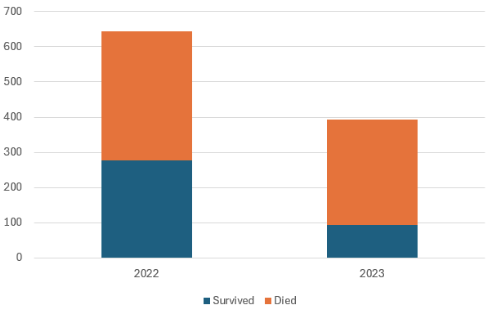
The Black Forest Fire of 2013 was one of the most destructive wildfires in Colorado’s history - in just nine days, it scorched over 14,000 acres of land. In the aftermath of the fire, RMFI has worked alongside El Paso County to restore the Ponderosa pine forest of the partially burnt Black Forest Regional Park (BFRP). RMFI began its restoration work in 2013 with an analysis of post-fire needs and began the installation of log erosion barriers. Fire destroys the vegetation and roots that shield and hold the soil together, leaving it exposed to the elements. Installing Log Erosion Barriers improves soil stability and limits erosion while plants re-establish themselves. RMFI continued this post-fire restoration work until around 2019. In 2022, RMFI volunteers returned to the BFRP and planted 645 Ponderosa pine saplings; in 2023, they planted an additional 300.
In March of 2026, as part of my Senior Capstone, RMFI returned to the BFRP to see how the saplings were faring. After counting the number of live saplings to the best of our ability, we estimate that the overall sapling survival rate was 39%. It was higher in 2022 (42.7%) than it was in 2023 (31.0%). It is unclear why the 2023 saplings had a lower survival rate, given that there was more precipitation in the spring and summer of 2023 than in 2022. In any case, these survival rates are conservative estimates; the exact location of every sapling planted is unknown, and we erred on the side of caution when we were uncertain whether or not a sampling had been planted by RMFI. In other words, the actual sapling survival rate is probably somewhat higher.
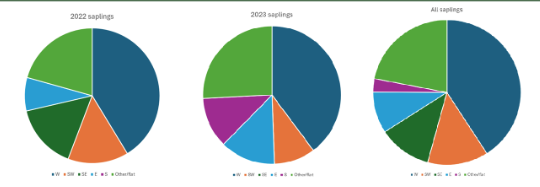
The saplings were planted within a 10-acre park area that had been left largely barren by the Black Forest Fire, in stark contrast to the pine forest encircling it. Over time, some vegetation has grown back across the hilly terrain – we encountered a lot of grasses, kinnikinnick, buffalo beans, and mullein. Kinnikinnick and buffalo beans were growing in patches on the sides and tops of the hills, often close to the path; meanwhile, grasses and mullein were mostly found in the bottoms of gullies. A large proportion (40.9%) of the surviving Ponderosa pine saplings were distributed across west-facing slopes and hills; often in close association with kinnikinnick and/or logs (including LEBs), which could aid survival by providing shade, cover from wind, and improving soil water retention. There were very few surviving Ponderosa pine saplings in the bottom of the gullies, suggesting that they may have been outcompeted by the more fast-growing mullein and grasses in these locations. There was also a hill on which no saplings had survived - upon further inspection, the ground was littered with vole burrows. Although the saplings were planted in biodegradable cages to prevent herbivory, they are above-ground only, and so they do little to deter voles from munching on sapling roots. See below for Konrad's charts.
All in all, we were delighted to see that our volunteers’ hard work has paid off. Thanks to you, BFRP is growing greener by the day!
Med vennlig hilsen,
Konrad
Thank you, Konrad, for all of your hard work over the course of your Bonner Fellowship. We wish you the best in the next steps after Colorado College!